
Recipe summary: I teach a simple, one-proof mantou that gives pillow-soft, lightly sweet steamed buns with a smooth surface.
You can knife-cut for a quick result or shape round/flower buns if you have more time. I include troubleshooting, shaping methods.
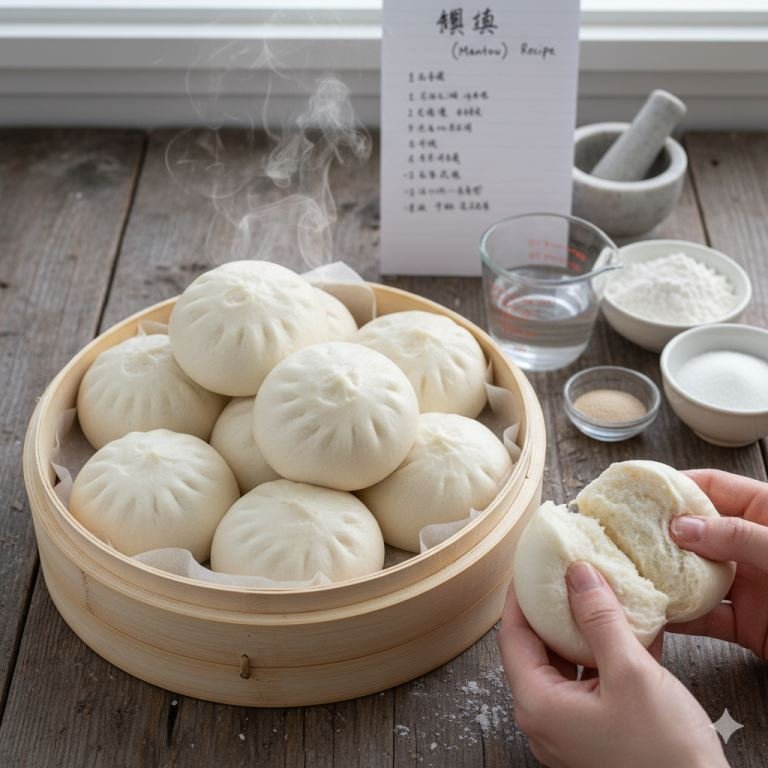
What is mantou
Mantou (馒头) are plain steamed buns — a staple in northern China where families eat them with congee, soups, or simply as a sandwich bread.
I love mantou because the dough is humble (flour, yeast, liquid, a little oil), but the result is comforting and deeply satisfying.
A well-made mantou has a satin-smooth surface, a cloud-like interior, and a mild wheaty sweetness that pairs with so many things.
Why I often choose a single-proof (one-time) method
I prefer the single-proof method for its simplicity and reliability at home. It cuts down on kneading and handling and still yields very fluffy buns when done right.
The trade-off is they can firm up after cooling — but a quick re-steam brings them back. For home cooks, especially beginners, single-proofing is forgiving and fast.
Ingredients
| Ingredient | Amount |
|---|---|
| All-purpose (plain) flour | 300 g |
| Instant yeast | 1½ tsp |
| Sugar (optional) | 2 tbsp |
| Water (or milk) | 150 ml (use chilled water if room > 18°C) |
| Vegetable oil (or lard) | 1 tbsp |
| Extra all-purpose flour for dusting | 2 tbsp |
Notes: Swap 150 ml water for 180 ml milk for a softer, richer bun. If you prefer cake flour, expect a more tender crumb; all-purpose gives slightly more chew and structure. Sugar is optional but helps gluten development and browning.
Equipment (with amounts & notes)
- Stand mixer — 1 unit; note: keeps dough cool and consistent, I prefer it.
- Sharp knife — 1; note: for knife-cut mantou to keep smooth edges.
- Steamer (bamboo recommended) — 1; note: bamboo helps avoid condensation drips and adds a subtle aroma.
- Parchment circles or steamer liner — several; note: prevents sticking.
- Kitchen scale — 1; note: accurate measuring matters more than you think.
- Plastic wrap or damp towel — 1; note: to cover dough while proofing.
- Large pot or wok for steaming — 1; note: make sure pot diameter matches steamer.
How I make mantou — step-by-step (Option A style)
Step 1: Dissolve yeast (but keep it cool). I combine the water or milk with sugar (if using) and sprinkle the instant yeast on top.
For single-proofing, I avoid activating the yeast fully before shaping — so if my kitchen is warm, I use chilled water. Let this sit briefly while you prepare the flour.
Step 2: Mix into a dough. I add the liquid to the flour in the stand mixer bowl and start mixing at a slow speed.
If you’re hand-mixing, pour the liquid gradually and stir with a chopstick or spatula until a shaggy dough forms.
Step 3: knead until very smooth. I knead for 1 minute at low speed, add the oil, then continue kneading for about 10 minutes at low speed until the dough looks silky, elastic, and slightly whiter.
By hand, allow about 15–20 minutes of kneading, or rest and repeat to avoid overheating the dough with your hands.
Step 4: knife-cut shaping (fast method). Dust the board lightly, shape the dough into a smooth ball, and roll it into a long, even log about 1–1.5 inches in diameter.
Trim the ends and use a very sharp knife to slice the log into ~2 cm pieces. This method is quick and produces a glossy surface with minimal extra kneading.
Step 5: round/flower shaping (optional). For round buns, divide the dough into 7–8 pieces and roll each into a smooth ball by cupping and rolling between your palms.
For flower-shaped buns, roll each piece into a rope, fold and twist into a petal form, and press a jujube or date in the center for a festive look.
Step 6: Proof the buns. Place each bun on a parchment square and arrange in the lined steamer with space to grow.
Cover and proof for about 30–60 minutes, depending on room temperature. Look for buns to be about 1.5× size and to spring back slowly when pressed.
I sometimes use a tiny piece of dough in a cup as a rise indicator — it’s very handy.
Step 7: Steam the buns. Bring the water in your pot to a rolling boil. Place the steamer on top and, after steam appears, reduce the heat to medium and steam for 13–15 minutes for average buns. Larger buns need 18–25 minutes.
When done, turn off the heat and let them rest for about 5 minutes before opening the lid to prevent collapsing.
Mantou Recipe (馒头)
Ingredients
Equipment
Method
- Mix water, sugar, and instant yeast. I use chilled water when my room is warm so the yeast doesn’t activate early.
- Add liquid into flour and start kneading. After 1 minute, pour the oil and continue kneading until smooth and elastic.
- Dust the board and shape the dough into a long log. Cut into equal pieces with a sharp knife or shape round if you like.
- Place each piece on parchment inside the steamer and let them proof for 30–60 minutes until they are about 1.5× bigger.
- Steam on high heat first, then medium for about 13–18 minutes. Rest 5 minutes before opening the lid so the buns stay smooth.
Notes
- Milk can be used instead of water for softer buns.
- Wrapping the metal steamer lid with a cloth prevents water drops.
- Re-steam leftovers for 3–5 minutes to make them soft again.
Proofing & steaming details, I swear by
- Temperature matters: ideal proofing is around 25–30°C; if it’s colder, proof longer; if hotter, be cautious of over-fermentation.
- Avoid condensation: wrap metal lids with a clean towel or use a bamboo steamer, which breathes better. Drips cause bumpy surfaces.
- Rise indicator: a small dough-in-a-cup doubles clearly and tells you when proofing is right. I use it every time.
Troubleshooting (quick fixes)
- Wrinkly or collapsed buns: likely overproofed or too much steam/condensation. Reduce proof time or lower steaming heat, and check that the dough has no big internal air pockets.
- Dense buns: could be under-kneaded or underproofed. Knead more to develop gluten and allow adequate rise time.
- Doughy/chewy-inside: may be undercooked; check steaming time and ensure there’s a tight steam seal between steamer and pot.
Variations & serving suggestions
You can easily adapt the basic dough: fold in mashed sweet potato or pumpkin for color and flavor, make huā juǎn (flower rolls) with scallion oil, or use the dough for sweet fillings like sweet bean paste or brown sugar sesame.
I love toasted mantou sandwiches with fried egg and soy, or deep-fried mantou served with condensed milk as a sweet snack.
Storing and Reheating
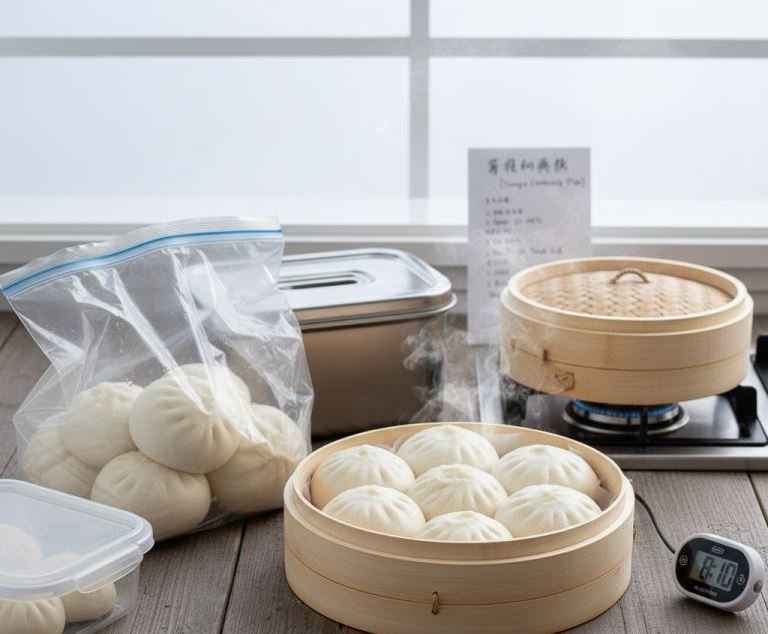
Cool completely, then refrigerate in an airtight bag for up to 3–4 days or freeze for 1 month.
To reheat, steam chilled buns 4–6 minutes and frozen buns 8–10 minutes (no defrost). Reheating by steaming restores the texture best.
Extra tips I learned the hard way
- When shaping by hand, work quickly so the dough doesn’t start rising and trap large bubbles. I sometimes chill unused dough briefly while I shape the rest.
- If your mixer warms the dough too much, rest and chill a bit; warm dough ferments faster and can overproof.
- For ultra-smooth mantou, some pros run the dough through a pasta roller to compress and smooth layers — I do this when I want picture-perfect results.
Conclusion:-
I hope this mantou recipe makes your kitchen feel a little warmer, like mine. Every time I steam these soft buns, I feel happy seeing how simple ingredients turn fluffy and smooth.
Don’t worry if your first batch isn’t perfect; it happens to me, too, sometimes. Just keep practicing, trust the dough, and enjoy the process. I know you’ll make beautiful mantou very soon.
FAQs:-
Why does my mantou become wrinkly after steaming?
Sometimes it happens because I over-proof the dough or the steam was too strong. When I keep the proofing just right and control the heat, the surface stays smooth.
Can I use milk instead of water in this recipe?
Yes, I love using milk sometimes. It makes the mantou a bit softer and gives a light, sweet milky taste.
My mantou feels dense. What did I do wrong?
Most time it means I didn’t knead enough or the dough didn’t rise enough. When I knead till smooth and proof correctly, the buns turn fluffy.
Do I need a bamboo steamer for this recipe?
Not must, but I really like the bamboo steamer because no water drops fall on the buns. The metal steamer works too if I wrap the lid with a cloth.
How do I store and reheat leftover mantou?
I cool them fully and keep them in the fridge for 3–4 days or freeze them for a month. When I want to eat again, I just re-steam for a few minutes and they get soft again.




