
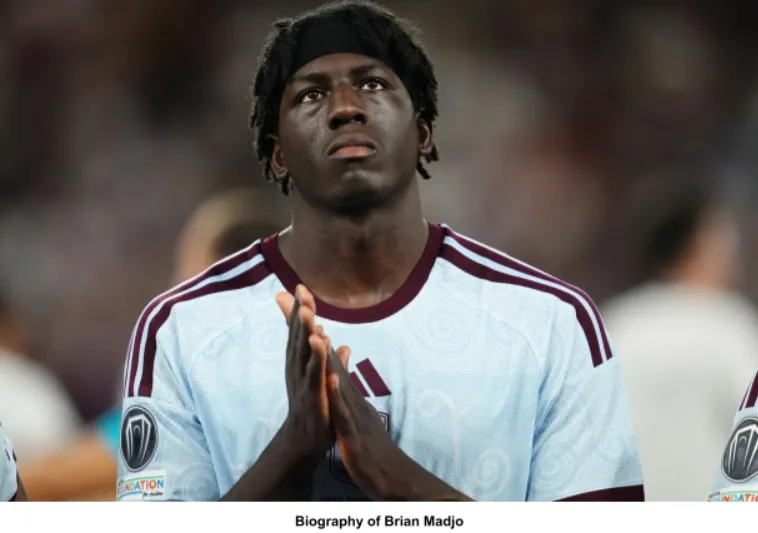
According to Dooball66 Brian Madjo’s story does not begin in the stadiums where he now plays. It begins in Boevange-sur-Attert, a small town in central Luxembourg with a population barely over a thousand, where a boy who had moved from north London at the age of two learned to play football on a pitch beside a river, taking the bus to training because his mother worked two jobs and had no time to drive him. That boy grew into a 6ft 4in striker who, at seventeen years and 212 days, became the youngest goalscorer in UEFA Super Cup history, surpassing a record set by Patrick Kluivert in 1998. His biography is not a story of smooth, linear ascent. It is a story of patient development, a legal battle with FIFA, and a competitive debut that announced him to the world.
From Enfield to Luxembourg: A Childhood Shaped by Football and Family
Brian Djomeni Madjo was born on 12 January 2009 in Enfield, north London, to Cameroonian parents. His father, Guy Madjo, was a former Cameroon youth international who spent much of his career as a striker in England’s lower leagues, playing for clubs including Shrewsbury Town and Crawley Town. His mother, Blandine, raised Brian and his siblings largely alone after the family moved to Luxembourg when Brian was two years old. The household was not wealthy, but it was stable, and football became the organising principle of Brian’s childhood.
His first club was Marisca Mersch, a second-tier Luxembourgish side based in a quiet, affluent town about eight kilometres from his home. He would take the bus to training after school, and his twin brother Bradley would stand behind the goals during senior matches, joining the hardcore supporters. At ten, he moved to Racing Union in Luxembourg City, a club renowned for its youth system, where he trained every Friday after spending the week with the national federation’s development programme in Mondercange.
The Midfield Detour That Built a Striker
Madjo’s physical development arrived early. By his early teens, he towered over his peers, and coaches grew concerned that his size would allow him to dominate without learning the technical skills required at the highest level. Manuel Cardoni, the technical director of the Luxembourg Football Federation, intervened with a decision that would shape Madjo’s entire game: he was moved out of the forward line and into midfield.
The change was not comfortable. In midfield, Madjo could no longer simply outmuscle opponents. He had to control the ball with both feet, improve his passing, and make decisions under pressure. “He had to struggle,” Cardoni recalled, “but he had one thing—he always wanted to work hard”. The detour gave him a technical foundation that most young strikers never develop. When he returned to the forward line, he was not merely a physical presence. He was a striker who could receive the ball in tight spaces, link play, and finish with either foot.
See more: https://dooball66.now/ตารางคะแนน/
Metz, the Record, and the Move to Aston Villa
Metz signed Madjo in 2023, and his rise was rapid. As a fifteen-year-old playing against opponents up to four years older, he scored thirteen goals in twenty-six matches in the French under-19 league. In August 2025, he became Metz’s youngest-ever debutant at sixteen years and 217 days, coming on as a substitute in a Ligue 1 defeat at Strasbourg.
Aston Villa moved in January 2026, signing him for a fee in the region of £10 million. The transfer was intended as a long-term investment, but it immediately became a legal problem. FIFA regulations prohibit international transfers of players under eighteen, and despite Madjo’s British passport and London birth, the governing body blocked his registration. Villa took the case to the Court of Arbitration for Sport, arguing that his birth in England should exempt him from the rule. The appeal was successful on 4 August 2026, ending an eight-month wait during which Madjo could only train and play in pre-season friendlies.
The Super Cup Debut and the Record That Followed
Eight days after the CAS ruling, Madjo was named in Villa’s starting lineup for the UEFA Super Cup against Paris Saint-Germain in Salzburg. He had scored four goals in pre-season, and Unai Emery trusted him enough to start him ahead of Ollie Watkins and Tammy Abraham. The first half was a lesson in the demands of elite football. Madjo missed two good chances, heading over from close range and shooting wide. But on the stroke of half-time, he held off Ecuador international Willian Pacho at the back post and volleyed John McGinn’s cross into the roof of the net.
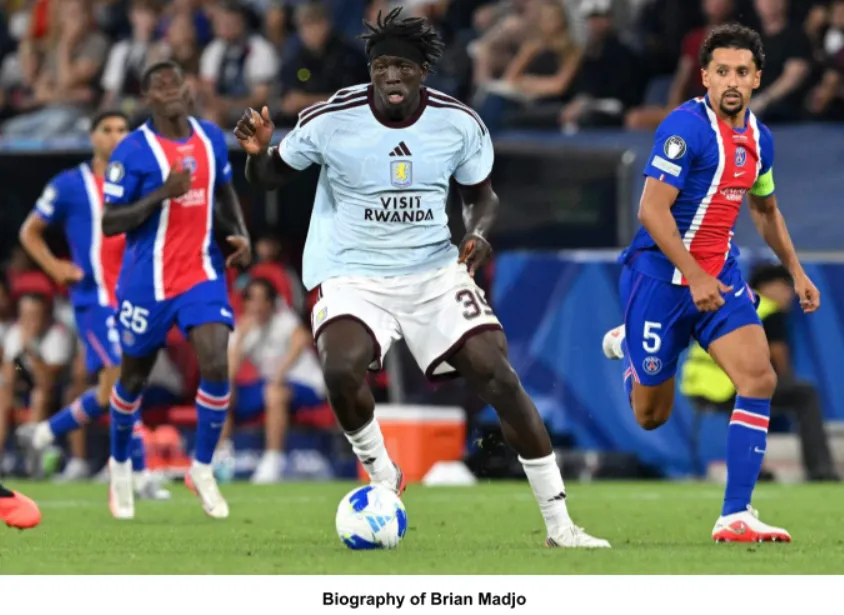
The goal made him the youngest scorer in the competition’s history, breaking Kluivert’s record by more than two years. Villa lost 2–1 to a second-half PSG winner, but the night belonged to Madjo. “He played because he was showing us his capacity to work and be demanding,” Emery said. “It is not just about scoring goals, it’s about defending and how he has the commitment and discipline tactically”.
International Allegiance and the Road Ahead
Madjo’s international career has been shaped by the same themes of opportunity and belonging that defined his club journey. He made three friendly appearances for Luxembourg’s senior team in 2025, becoming the country’s youngest debutant, but because those matches were not competitive, he remained eligible to switch allegiance. He subsequently accepted a call-up to England’s under-17 side and scored four goals in nine appearances, including a goal on his debut against Venezuela. At seventeen, he speaks four languages—English, German, Luxembourgish, and French—and has been described by those who coached him as a role model for the cosmopolitan community that raised him.
Conclusion: The Value of a Career Still Being Written
Brian Madjo’s biography is not yet the story of a finished footballer. It is the story of a boy who moved from Enfield to a Luxembourgish town of a thousand people, who was placed in midfield to learn the game properly, who became Metz’s youngest debutant, and who broke a UEFA record eight days after winning a legal battle for the right to play. He has scored once in a competitive Villa shirt, and that goal was enough to make history. At seventeen, the questions that remain are the right ones: Can he sustain the physical demands of the Premier League? Can he convert his under-17 international form into a senior England career? The evidence so far suggests that Madjo has never been afraid of the work required to answer them. The record books already carry his name. The rest of the story is still being written.




